Showing posts with label ceramic tiles. Show all posts
Showing posts with label ceramic tiles. Show all posts
Wednesday, April 1, 2015
Characteristics
|
Floors
|
Walls
|
Test
| ||
Dimensions and surface quality
|
Interior
|
Exterior
|
Interior
|
Exterior
|
Reference
|
Length and width
|
X
|
X
|
X
|
X
|
ISO 10545-2
|
Thickness
|
X
|
X
|
X
|
X
|
ISO 10545-2
|
Straightness of sides
|
X
|
X
|
X
|
X
|
ISO 10545-2
|
Rectangularity
|
X
|
X
|
X
|
X
|
ISO 10545-2
|
Surface flatness (curvature and warpage)
|
X
|
X
|
X
|
X
|
ISO 10545-2
|
Surface quality
|
X
|
X
|
X
|
X
|
ISO 10545-2
|
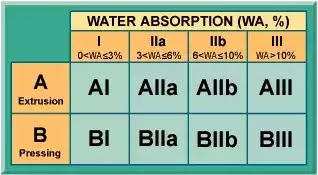
These are the definitions given in ISO 13006 for ceramic tiles.
Ceramic tiles
thin slabs made from clays and/or other
inorganic raw materials, generally used as coverings for floors and walls,
usually shaped by extruding (A) or pressing (B) at room temperature but may be
formed by other processes (C), then dried and subsequently fired at
temperatures sufficient to develop the required properties; tiles can be glazed
(GL) or unglazed (UGL) and are incombustible and unaffected by light
Vitrified covering which is impermeable
Engobed surface
Clay-based covering with a matt finish which
can be permeable or impermeable
NOTE : A tile with an engobed
surface is regarded as an unglazed tile.
Polished surface
Surface of an unglazed tile which has been
given a glossy finish by mechanical polishing as the last stage of manufacture
Extruded tiles
[Designated as A]
Tiles whose body is shaped in the plastic
state in an extruder, the column obtained being cut into tiles of pre-
determined dimension
NOTE 1: This International Standard
classifies extruded tiles as “precision” or “natural”. The classification is
dependent upon the different technical characteristics as listed in the
individual product standards.
NOTE 2: Traditional terms used
for extruded products are “split tiles”
and “quarry tiles” They
commonly indicate double-extruded and single-extruded tiles
respectively. The term “quarry tiles” only refers to extruded tiles with a
water absorption not exceeding 6 %.
Dry-pressed tiles
[Designated as B]
Tiles formed from a finely milled body
mixture and shaped in moulds at high pressure
Tiles made by other processes
[Designated as C]
Tiles made by other than the normal
commercial processes, i.e. extruded or dry-pressed
NOTE : These tiles are not covered
in this International Standard.
Spacer lugs
projections which are located along
certain edges of tiles so that when two tiles are placed together, in line, the
lugs on adjacent edges separate the tiles by a distance not less than the
specified width of the joint
NOTE 1: Lugs are positioned so that the
joint between the tiles may be filled with grout without the lugs remaining
exposed. NOTE 2 Dry-pressed tiles may be made with other spacer lug systems
and, in such cases, the manufacturer’s work size applies.
Water absorption
[Symbol E]
Percentage of water by mass, measured in
accordance with ISO 10454-3
Description of sizes
NOTE : These are only defined for
rectangular tiles. If the sizes of non-rectangular tiles are required, they are
defined by the smallest rectangle into which they will fit.
Nominal size
Size used to describe the product
Work size [symbol W]
Size of a tile specified for manufacturing
to which the actual size has to conform within specified permissible deviations
NOTE: This is specified by the dimensions
length, width and thickness.
Actual size
Size obtained by measuring the face of the
tile in accordance with ISO 10545-2
Coordinating size [symbol C]
Work size plus the joint width
Modular size
tiles and sizes based on module M, 2 M, 3
M and 5 M and also their multiples or subdivisions, except for tiles with a
surface area of less than 9 000 mm2

The below test methods are used for checking physical and chemical properties of Ceramic tiles.
- ISO 1006:1983, Building construction — Modular coordination — Basic module.
- ISO 10545-1:1995, Ceramic tiles — Part 1: Sampling and basis for acceptance.
- ISO 10545-2:1995, Ceramic tiles — Part 2: Determination of dimensions and surface quality.
- ISO 10545-3:1995, Ceramic tiles — Part 3: Determination of water absorption, apparent porosity, apparent relative density and bulk density.
- ISO 10545-4:1994, Ceramic tiles — Part 4: Determination of modulus of rupture and breaking strength.
- ISO 10545-5:1996, Ceramic tiles — Part 5: Determination of impact resistance by measurement of coefficient of restitution.
- ISO 10545-6:1995, Ceramic tiles — Part 6: Determination of resistance to deep abrasion for unglazed tiles. ISO 10545-7:1996, Ceramic tiles — Part 7: Determination of resistance to surface abrasion for glazed tiles. ISO 10545-8:1994, Ceramic tiles — Part 8: Determination of linear thermal expansion.
- ISO 10545-9:1994, Ceramic tiles — Part 9: Determination of resistance to thermal shock.
- ISO 10545-10:1995, Ceramic tiles — Part 10: Determination of moisture expansion.
- ISO 10545-11:1994, Ceramic tiles — Part 11: Determination of crazing resistance for glazed tiles.
- ISO 10545-12:1995, Ceramic tiles — Part 12: Determination of frost resistance.
- ISO 10545-13:1995, Ceramic tiles — Part 13: Determination of chemical resistance.
- ISO 10545-14:1995, Ceramic tiles — Part 14: Determination of resistance to stains.
- ISO 10545-15:1995, Ceramic tiles — Part 15: Determination of lead and cadmium given off by glazed tiles.
- ISO 10545-16:—1 , Ceramic tiles — Part 16: Determination of small colour differences.
- ISO 10545-17:—1), Ceramic tiles — Part 17: Determination of coefficient of friction.
Subscribe to:
Posts (Atom)